Explore high-performance architectural wood-plastic composites, acoustic slatted panels, and flexible decorative engineering solutions.
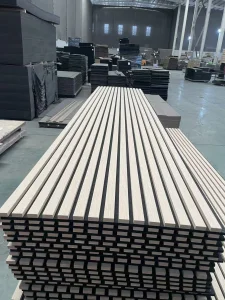
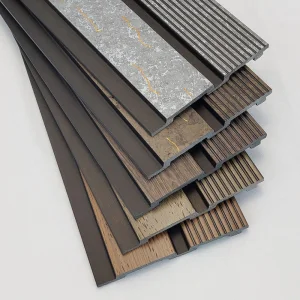
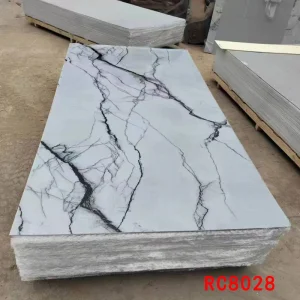
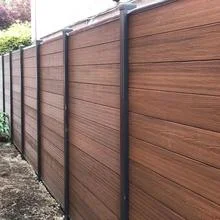
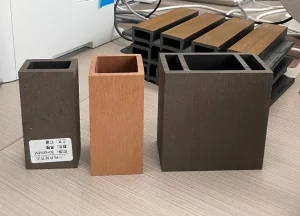
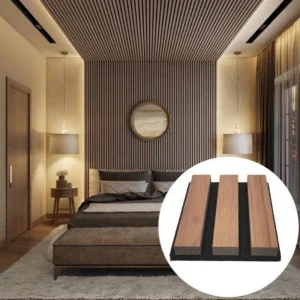
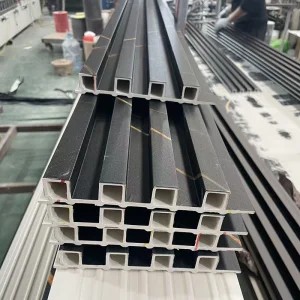
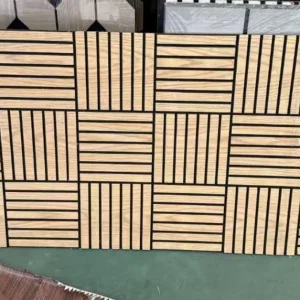
Unlocking organic curves, fluid geometry, and structural longevity with advanced thermoformable wood-plastic composites.
In contemporary architectural design, the linear constraints of traditional building materials are increasingly giving way to organic curves, cylindrical columns, sweeping wave walls, and continuous parametric facades. Historically, achieving curved wood aesthetics required labor-intensive steam bending, kerf-cutting natural timber, or applying delicate thin veneers over flexible plywood sub-frames—processes notorious for high scrap rates, structural vulnerability to moisture, and long-term delamination.
The emergence of Bend WPC (Flexible Wood-Plastic Composite) manufactured by leading Chinese industrial factories represents a landmark technical evolution. By re-engineering the polymer matrix—blending ultra-fine recycled hardwood fibers or eco-friendly bamboo micro-powders with modified thermoplastic resins (such as high-density polyethylene, polyvinyl chloride, or polypropylene) and specialized elastomer plasticizers—manufacturers have created a composite material capable of tight cold-bending radiuses and seamless thermoforming application.
Formulated with specialized coupling agents and elastomeric polymers, Bend WPC can achieve smooth cold-bend curves down to a 300mm radius without surface fracturing or structural stress-crazing.
Integrating activated bamboo charcoal sub-layers enhances internal cohesion and tensile strength, preventing thermal expansion deformities across varying humidity zones.
Impregnated with flame-retardant additives (achieving B1-s1, d0 fire rating standards), Bend WPC resists water absorption (<0.5%), eliminating mold, rot, and swelling risks inherent to natural wood.
For commercial interior contractors, architectural specifiers, and international distributors, sourcing Bend WPC from specialized Chinese suppliers provides access to highly scalable manufacturing capacity, precision CNC grooving customization, and cost-effective bulk shipping configurations tailored for immediate jobsite assembly.
Inside China's premier building material production cluster: Advanced automation, massive scale, and stringent quality control.
Centralized in Linyi City, Shandong Province—the world’s largest manufacturing hub for modern wood-plastic composites and engineered timber substitutes—leading manufacturers like LINYI RICH NEW MATERIALS CO., LTD. set the global benchmark for production volume, technological integration, and material research.
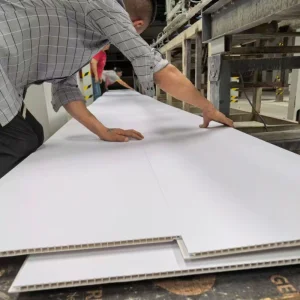
Linyi Rich New Materials Co., Ltd. operates as a modern industrial powerhouse integrating R&D, precision manufacturing, and international commerce. Operating across a 100,000 m² state-of-the-art facility staffed by over 300 skilled technicians, the company maintains extensive line automation designed for global OEM/ODM supply agreements:
Quantitative analysis evaluating Flexible Bend WPC against conventional wall cladding and rigid building substrates.
| Performance Metric | Bend WPC (Flexible Core) | Standard Rigid WPC | Natural Hardwood | Aluminum Composite (ACP) |
|---|---|---|---|---|
| Min. Cold Bending Radius | R 300 mm | R 2,500 mm (Cracks) | Not Flexable (Requires Steam) | R 500 mm (Needs V-Groove) |
| Water Absorption Rate | < 0.3% (Impermeable) | < 0.8% | 12% - 25% (Swell Risk) | 0.0% |
| Fire Retardancy Rating | B1-s1, d0 (Flame Retardant) | B1-s1, d0 | B3 (Combustible) | A2 / B1 Class |
| Formaldehyde Emission | E0 / Super E0 (Zero Toxicity) | E0 Grade | Varies by VOC Finish | Zero Formaldehyde |
| Surface Scratch Hardness | ≥ 4H (UV Coated Layer) | 3H - 4H | 2H - 3H (Easy Dent) | 3H (Anodized/PVDF) |
| Thermal Expansion (CLTE) | 3.5 × 10⁻⁵ / K | 4.2 × 10⁻⁵ / K | Anisotropic Shrinkage | 2.4 × 10⁻⁵ / K |
| Acoustic Isolation (NRC) | 0.65 - 0.85 (Slatted Acoustic) | 0.15 | 0.10 | 0.05 |
*Data verified under ISO9001 quality management protocols and EN 13501-1 fire safety certifications. Test reports available upon commercial inquiry.
Bridging aesthetic elegance with industrial durability across commercial, hospitality, and residential architecture.
Wrapping structural support columns in hotel lobbies, airport lounges, and retail flagship stores previously required expensive custom millwork or curved drywall finishing. Flexible Bend WPC panels enable seamless wrap-around cladding with concealed interlocking joints. The micro-fluted textures add visual depth while shielding high-traffic columns from physical impacts and cleaning chemicals.
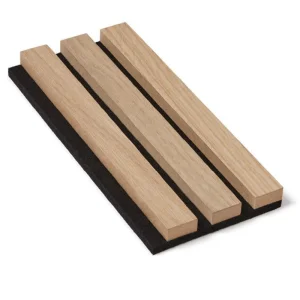
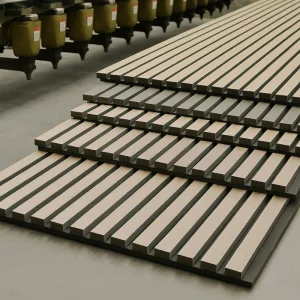
In modern auditoriums, open-plan corporate offices, and luxury residential home theaters, controlling reverberation time (RT60) is paramount. By combining flexible bamboo charcoal WPC substrates with sound-absorbing recycled PET felt backings, acoustic bend panels can wrap fluidly around concave ceilings and serpentine feature walls, achieving superior Noise Reduction Coefficients (NRC > 0.75).
Traditional wood veneers immediately warp, discolor, and delaminate in elevated humidity zones such as luxury spas, indoor swimming pool surrounds, and residential master bathrooms. China Bend WPC features 100% waterproof synthetic binding agents and closed-cell polymer structures that remain dimensionally stable under continuous moisture exposure and thermal fluctuation.
As global construction accelerates toward modular prefabrication (Off-site Construction), contractors require lightweight, easy-to-install materials that minimize jobsite cutting waste. Bend WPC panels can be factory CNC pre-routed and shipped flat, allowing rapid snap-lock assembly on-site. This drastically reduces installation labor costs by up to 60% compared to traditional wet plaster or real timber installation.
Mitigating supply chain risks, verifying factory authenticity, and optimizing logistics for international B2B buyers.
Procuring Bend WPC profiles and composite wall systems from Chinese manufacturers requires a structured strategy to ensure product consistency, compliance with localized building codes, and container loading efficiency. Foreign importers, wholesale distributors, and EPC contractors should evaluate potential suppliers against key procurement pillars:
Ensure the manufacturer uses 100% virgin polymer resins or fully characterized recycled grade polymers with uniform melt flow index (MFI). Low-quality fillers increase brittleness, resulting in panel snapping during cold bending.
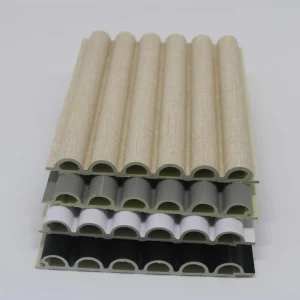
Top-tier suppliers like Linyi Rich maintain over 200 extrusion molds for semicircle, fluted, flat, and corrugated profiles. Custom die tooling capabilities allow architects to specify unique profile geometry with minimal tooling lead times.
Verify that decorative PVC or wood grain films utilize PUR (Polyurethane Reactive) hot-melt adhesive lamination rather than standard solvent adhesives. PUR lamination guarantees zero edge peeling, even when panels are bent to acute angles.
Because flexible and bendable WPC profiles often feature hollow fluted chambers or lightweight core structures, optimizing volumetric loading density in 40ft High Cube (40HQ) shipping containers is critical to minimizing per-unit freight costs. Reputable Chinese factories utilize protective PE film masking, corner-edge guards, and reinforced wooden crate packaging designed for forklift handling and zero transport shock damage.
Direct answers to engineering, installation, and procurement questions commonly raised by architectural specifiers.
A: Bend WPC incorporates elastomeric modifier agents (such as TPU/CPE) and specialized silane coupling additives into the PVC/PE polymer blend. This matrix flexibility, combined with ultra-fine bamboo/wood microfiber particle sizing, allows the panel to absorb flexural strain during cold bending without micro-cracking or visual surface stress-whitening.
A: For standard 5mm to 8mm thick bamboo charcoal carbon fiber flexible WPC panels, the cold bend radius can reach as tight as R 300 mm. For thicker fluted WPC profiles (12mm–15mm), a cold bend radius of R 800 mm is recommended. Radiant heat guns can be utilized during installation to achieve even tighter custom curves.
A: Indoor-grade Bend WPC panels feature PVC/bamboo charcoal cores optimized for interior climate stability. For exterior architectural facades, specified Co-Extruded ASA/PE Outdoor WPC Cladding must be used. Outdoor grade panels incorporate anti-UV stabilizers and ASA capping layers to withstand severe weather, direct sunlight, and thermal cycles without fading.
A: Installation is straightforward: panels are secured directly to curved drywall or plywood substrates using high-tack, fast-curing polyurethane structural adhesive (nail-free glue) combined with pneumatic stainless-steel brad nails driven into the tongue-and-groove lip edges for immediate mechanical retention while the adhesive sets.
A: Leading factories like Linyi Rich New Materials comply strictly with ISO9001 Quality Management Systems. Their products undergo third-party testing (SGS, Intertek, TÜV) confirming compliance with EU REACH regulations, RoHS standards, and CE certifications, alongside Super E0 low-VOC emission ratings.
A: Standard lead time for a standard 40ft HQ container (approx. 3,000 to 5,000 sqm of WPC panels) is typically 10 to 15 calendar days. For customized tooling profiles or proprietary surface colors, mold production and sample approval require an additional 7 to 10 days.
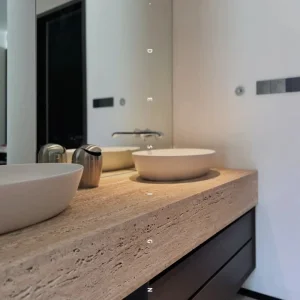
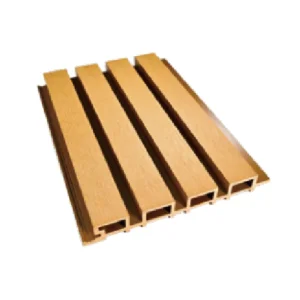
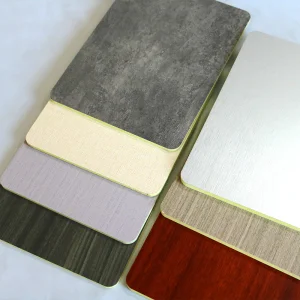
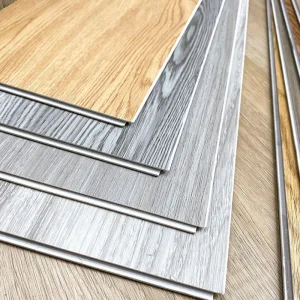
Comprehensive interior and exterior composite solutions, flexible stone veneers, acoustic panels, and resilient SPC systems.
Accelerate your project timelines and expand profit margins with factory-direct Bend WPC engineering solutions.
Whether you are an international importer sourcing container-load shipments, a building materials distributor expanding your eco-friendly product portfolio, or an architectural firm seeking custom flexible wall cladding profiles, Linyi Rich New Materials Co., Ltd. offers unmatched production capacity, certified environmental compliance, and reliable OEM/ODM engineering support.
 Rich New Materials