Premium architectural solutions engineered for Bay Area luxury residential and commercial developments
Navigating Microclimates, LEED Platinum Standards, and Silicon Valley Aesthetic Expectations
The San Francisco Bay Area represents one of the most sophisticated, ecologically conscious, and high-value architectural markets in North America. From Silicon Valley tech headquarters in South Bay to luxury mid-rises in SoMa, high-density residential towers in the Financial District, and restored Victorian residences in Pacific Heights, building material specifications face unprecedented scrutiny. Interior designers, general contractors, and commercial developers in San Francisco demand materials that seamlessly bridge ultra-modern aesthetics, structural longevity, and uncompromising environmental purity.
A primary driver for interior cladding specification in the Bay Area is local environmental condition. San Francisco's unique coastal microclimate—characterized by frequent marine fog layers (such as the infamous "Karl the Fog"), relative humidity swings between 60% and 85%, and salty sea air—exerts significant hydro-thermal stress on traditional interior wood finishes. Solid timber and standard MDF (Medium-Density Fiberboard) veneers frequently suffer from delamination, warping, mold growth, and off-gassing under fluctuating indoor relative humidity. Consequently, the demand for high-performance engineered composite substrates like Bamboo Charcoal Wood Veneers has surged by over 42% year-over-year in Northern California.
San Francisco municipal building codes mandate strict adherence to LEED Gold/Platinum standards. Material selections must deliver ultra-low VOC profile (E0/CDPH Standard Method v1.2) to qualify for indoor environmental quality credits.
Coastal moisture requires non-porous, hydrophobic core matrices. Bamboo charcoal wood veneers exhibit near-zero water absorption (<0.1%), eliminating swelling, mold propagation, and dimensional warping.
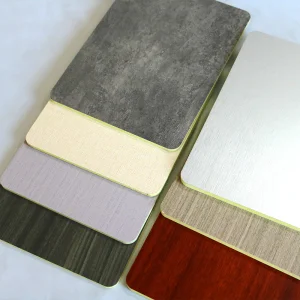
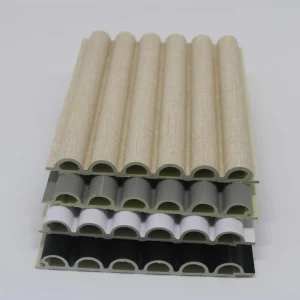
Tech campuses emphasize biophilic design combined with sleek industrial finishes—seamless curved wall corners, metallic or slate textures, and acoustic absorption for open-plan collaborative spaces.
Furthermore, local California environmental regulations—specifically CARB Phase 2 compliance, Title 24 Energy Code updates, and Proposition 65 chemical mandates—require material suppliers to provide rigorous third-party verification. Procurement managers sourcing for San Francisco projects can no longer rely on brokers; they require direct factory partnerships capable of delivering fully certified, custom-engineered, and fire-retardant bamboo charcoal veneer panels directly to the Port of Oakland without supply chain latency.
Understanding the molecular advantage of active bamboo charcoal polymer matrices
Bamboo charcoal wood veneer is not merely a decorative surface laminate; it is a bio-composite polymer wall system engineered through high-temperature carbonization. Sustainable moso bamboo undergoes anaerobic pyrolysis at temperatures exceeding 800°C to 1000°C. This extreme thermal process transforms raw bamboo fibers into activated bamboo charcoal powder featuring an extraordinarily dense micro-porous structure with immense specific surface area (up to 300–500 m²/g).
When this nano-charcoal powder is co-extruded under high pressure with premium virgin PVC resins, calcium carbonate, and non-toxic stabilizers, it creates a rigid, dense core matrix. The active charcoal particles act as natural molecular sieves within the wall panel structure, performing three vital mechanical functions:
Unrivaled scale, precision automation, and global supply chain efficiency
Headquartered in Linyi City, Shandong Province—the international hub for eco-friendly decorative material manufacturing—Linyi Rich New Materials Co., Ltd. operates as a modernized industrial enterprise integrating R&D, advanced extrusion, and global distribution. For San Francisco architectural firms and wholesale distributors, direct collaboration with Linyi Rich delivers an insurmountable competitive edge over local distributors operating through multi-tiered broker channels.
By eliminating intermediary trading markups and utilizing fully automated, continuous extrusion lines, Linyi Rich provides San Francisco contractors with factory-direct pricing (savings of 35%–50% per square foot compared to US stockists) while maintaining strict batch-to-batch color consistency.
Equipped with proprietary multi-axis CNC engraving and grooving machinery, our facility allows custom surface profiling, fluting, slots for integrated LED lighting strips, and pre-mitered edge fold profiles tailored to complex San Francisco commercial specs.
Tailored interior cladding solutions for the unique building typologies of the Bay Area
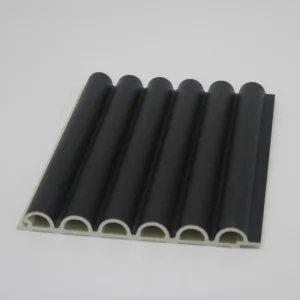
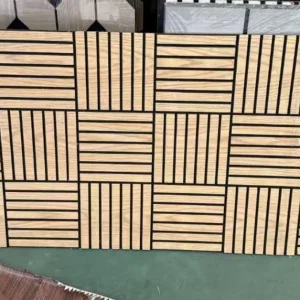
Modern open-plan offices in South Bay and SoMa require acoustic management paired with clean biophilic textures. Bamboo charcoal acoustic wood slat panels absorb background chatter while creating striking, zero-formaldehyde wall features in conference rooms and executive boardrooms.
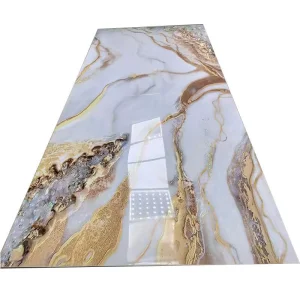
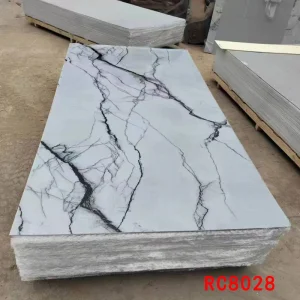
High-end residential renovations demand timeless elegance. Metallic texture and book-matched marble bamboo charcoal veneers offer the visual weight of real Italian stone or brushed brass without the excessive structural dead load or seismic installation complexity.
Restaurants, hotels, and retail spaces near the Embarcadero deal with constant damp air and heavy foot traffic. Hydrophobic bamboo charcoal veneers resist ambient humidity and feature an scratch-resistant UV coating that simplifies daily maintenance.
Engineered to surpass US Building Standards, ASTM Tests, and California Regulations
| Performance Parameter | Test Standard / Method | Bamboo Charcoal Veneer Rating | Architectural Relevance for SF Market |
|---|---|---|---|
| Formaldehyde Emission | EN 717-1 / CARB Phase 2 | E0 Grade (Non-detectable / ≤0.005 mg/m³) | Exceeds CA Proposition 65 & LEED v4 Low-Emitting Material credits. |
| Fire Reaction Rating | ASTM E84 / EN 13501-1 | Class A / B1-s1, d0 (Flame retardant) | Mandatory for high-rise commercial corridors & public gathering spaces. |
| Water Absorption Rate | ASTM D570 | < 0.08% (Hydrophobic Core) | Prevents warping, rotting, and mold growth in humid coastal microclimates. |
| Density & Hardness | ISO 1183 | 1.25 – 1.35 g/cm³ / Shore D 80 | High impact resistance against structural dints and commercial wear. |
| Flexural Strength | ASTM D790 | ≥ 45 MPa (Cold-bendable to 90°) | Enables seamless column wrapping and curved wall corner architectural profiles. |
| Sound Attenuation | ISO 354 / ASTM C423 | NRC 0.75 - 0.85 (With acoustic backing) | Optimizes room acoustics for open Silicon Valley tech offices & home theaters. |
| Thermal Expansion | ISO 11359 | ≤ 2.5 × 10−&sup5; / °C | Ensures dimensional stability during sharp seasonal temperature shifts. |
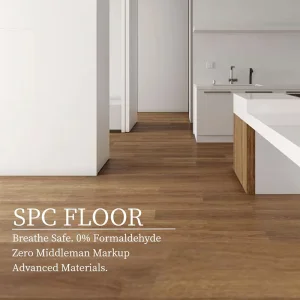
Explore our full ecosystem of integrated eco-friendly wall systems, ceilings, and flooring
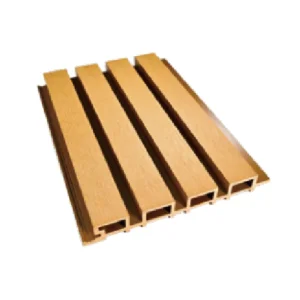
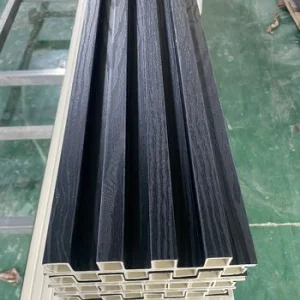
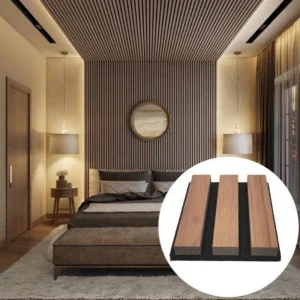
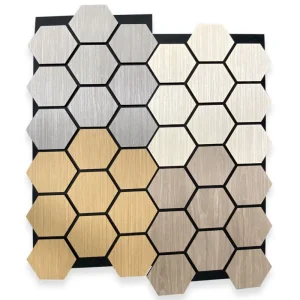
Decarbonizing building interiors through fast-renewable bio-materials
The global interior wall cladding market is undergoing a fundamental structural transition away from resource-intensive hardwood timber and carbon-heavy ceramic tiles toward circular, engineered bio-composites. Bamboo is widely recognized by architectural environmental scientists as the ultimate sustainable raw material due to its rapid growth cycle—reaching structural maturity in just 3 to 5 years compared to 40–80 years for traditional hardwoods like oak, walnut, or teak.
By utilizing industrial bamboo by-products and carbonizing them into high-density charcoal, Linyi Rich effectively locks carbon within interior building structures for decades, providing a carbon-negative footprint prior to transport.
San Francisco construction labor rates are among the highest globally. Bamboo charcoal wood veneers feature tongue-and-groove or aluminum clip interlock systems that reduce wall installation times by up to 65% compared to traditional plaster or heavy stone slab installs.
As corporate real estate developers across North America commit to Net-Zero Carbon building pledges by 2030, specifying certified bamboo charcoal wood veneer wall systems provides a measurable reduction in embodied carbon (LEED v4 MR Credit: Building Product Disclosure and Optimization).
Direct ocean freight, customs clearance readiness, and warehouse distribution
We leverage direct ocean container shipping routes from Qingdao/Lianyungang ports directly to the Port of Oakland, California, minimizing transit days down to 14–18 ocean days.
Panels are packed in heavy-duty moisture-proof plastic film, reinforced edge protectors, and IPPC-stamped ISPM-15 compliant fumigated wooden pallets to prevent transit damage.
Whether you require FOB Qingdao pricing or full DDP (Delivered Duty Paid) to your construction site in San Francisco, San Jose, or Oakland, our logistics team manages full customs filing.
Direct answers for San Francisco Architects, General Contractors, and Procurement Officers
Contact our engineering export team today for factory-direct price sheets, full technical test reports, and complimentary sample boxes delivered directly to your Bay Area office.
Send Inquiry Now Rich New Materials