Precision-engineered interior and exterior surface systems manufactured under strict ISO9001 and CE quality standards.
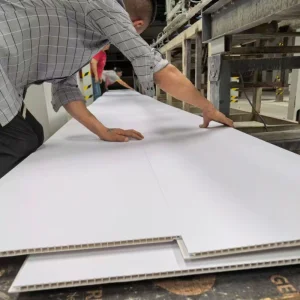
Understanding the engineering footprint of Linyi Rich New Materials Co., Ltd. in global composite supply chains.
Linyi Rich New Materials Co., Ltd. is a modernized industrial enterprise integrating R&D, chemical polymer engineering, high-precision extrusion manufacturing, and international trade. Located in Linyi City, Shandong Province—the largest wood processing and logistics hub in China—the enterprise operates an intelligent manufacturing footprint spanning over 100,000 square meters.
With a technical workforce exceeding 300 specialist engineers, the facility houses 120 fully automated WPC grating lines (12M m²/year capacity), 40 outdoor WPC lines (2M m²/year capacity), 4 high-precision SPC flooring lines (3M m²/year capacity), and 12 UV panel lines (6M m²/year capacity), along with carbon fiber and acoustic composite processing units.
Integrated Supply Chain Advantage: From micro-milled bamboo wood flour preparation to thermoplastic resin compounding, UV nano-coating, and high-precision CNC grooving—all processes are monitored under ISO9001 quality management systems.
How elastomeric modification converts rigid wood-plastic composites into bendable, high-tenacity architectural veneers.
Traditional WPC relies heavily on rigid PVC or PE matrices paired with high ratios of calcium carbonate ($CaCO_3$). Flexible WPC introduces thermoplastic elastomers (TPE/TPU) and chlorinated polyethylene (CPE) impact modifiers, lowering the modulus of elasticity while preserving tensile strength.
Utilizing dual-screw co-extrusion technology, flexible WPC wall panels feature a closed-cell micro-foamed core layer. This cellular architecture absorbs physical deflection, enabling cold-bending around curved columns down to a 300mm radius without cracking.
The exterior face is bonded with a multi-pass UV-cured acrylic polyurethane layer. This provides zero-formaldehyde environmental safety, scratch protection (Mohs scale 4+), and resistance to thermal degradation from solar radiation.
| Engineering Property | Standard Rigid WPC | China Flexible WPC (Rich Build) | Test Standard Benchmark |
|---|---|---|---|
| Flexural Modulus (MPa) | 2800 - 3500 (Brittle under stress) | 800 - 1400 (Highly Ductile) | ASTM D790 / ISO 178 |
| Minimum Cold Bend Radius | Not Applicable (Requires Heat Shaping) | 300 mm Radius (No Micro-cracking) | Internal Engineering Radius Spec |
| Impact Resistance (Charpy Notch) | 3.5 - 5.0 kJ/m² | 12.0 - 18.5 kJ/m² | ISO 179 / ASTM D256 |
| Water Absorption Ratio (24h immersion) | < 1.2% | < 0.25% (Closed-Cell Polymeric) | ASTM D570 |
| Fire Retardancy Rating | Class B2 / HB | Class B1 / ASTM E84 Class A Option | EN 13501-1 / ASTM E84 |
| Formaldehyde Emission | E1 / E0 Standard | ENF Grade (Non-detectable Zero VOC) | GB/T 39600-2021 |
Diversified building material solutions produced across Linyi Rich's specialized industrial divisions.
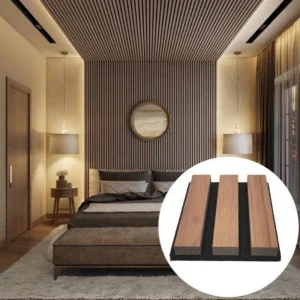
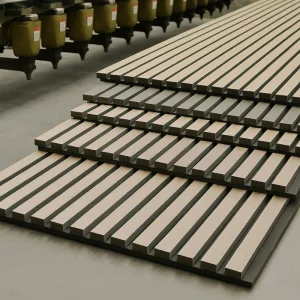
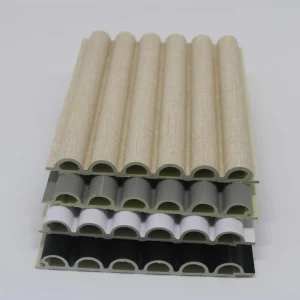
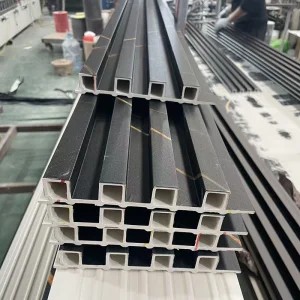
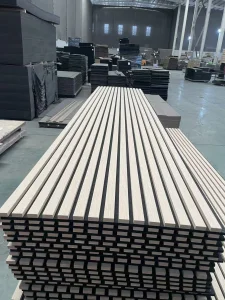
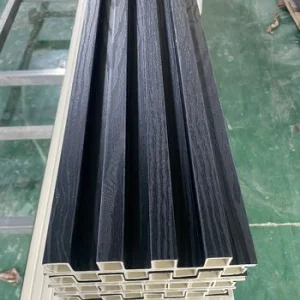
Operating 120 fully automated lines with an annual capacity of 12 million m². Engineered for vertical wall cladding, room dividers, and suspended architectural ceilings with rich timber aesthetic textures.
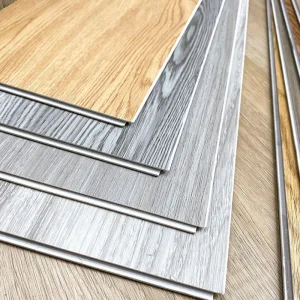
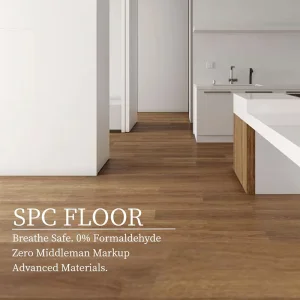
Powered by 4 high-precision extrusion production lines (3 million m²/year). Features rigid core construction, Unilin click system locking, IXPE sound pad backing, and 100% waterproof resilience.
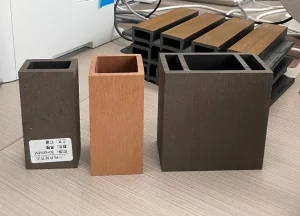
Supported by 40 customized heavy-duty extrusion lines (2 million m²/year). Encased in 360-degree protective fluoropolymer shells to resist UV fading, rot, decay, and extreme temperature flux.
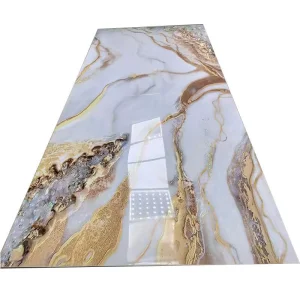
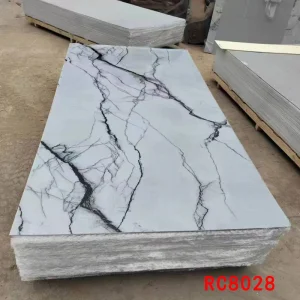
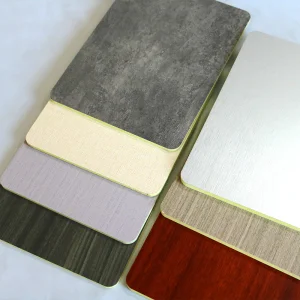
Utilizing 12 specialized dust-free UV coating lines (6 million m²/year). Delivers lightweight natural stone, onyx, and granite architectural replications for high-traffic commercial interiors.
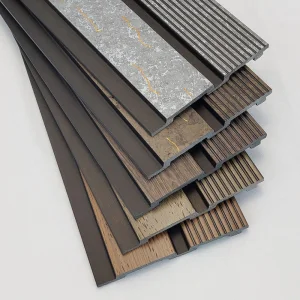
Driven by 6 continuous carbon-hybrid lines (1 million m²/year). Designed with high tensile stiffness, lightweight structural profiling, and custom CNC grooving capabilities for curved installations.
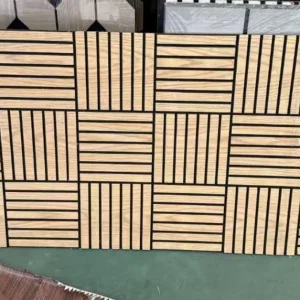
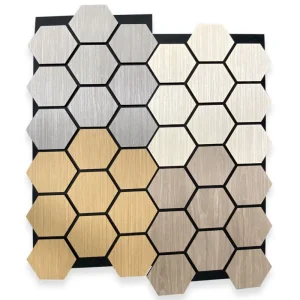
Equipped with automated multi-blade slit saws and sound-absorbing PET felt backing lines. Achieves NRC sound absorption ratings up to 0.85 for theaters, conference spaces, and luxury residences.
Deploying flexible composite technologies across demanding commercial, residential, and industrial environments worldwide.
Conventional rigid wood panels require expensive thermoforming or kerf-cutting on job sites. China flexible WPC sheets conform smoothly around structural columns, spiraling staircases, and organic wave walls, cutting labor installation costs by up to 60%.
In hotel lobbies, spa centers, and indoor swimming facilities, natural wood swells and degrades. Flexible WPC wall panels combine real wood grain visual textures with zero moisture permeability, eliminating mold growth and swelling risks.
Exported to North America, Europe, and the Middle East, our co-extruded outdoor WPC cladding withstands freeze-thaw cycles (-40°C) and scorching desert heat (+65°C) without cracking, peeling, or structural warping.
Key technical criteria B2B importers, architects, and wholesalers must audit when selecting China WPC factories.
Verify that the factory utilizes virgin PVC/PE polymers with precise wood flour mesh sizes (80-100 mesh). Oversaturated calcium carbonate reduces flexibility and creates brittleness.
Ensure linear thermal expansion coefficients are kept below $8.5 \times 10^{-5} K^{-1}$ to prevent panel buckling during seasonal temperature shifts.
Check peeling strength using PUR hot-melt adhesives. High-quality WPC panels resist delamination under 95% relative humidity conditions.
Confirm compliance with EN 13501-1 (Class B-s1, d0) or ASTM E84, essential for high-rise commercial interior code approvals.
Expert answers regarding manufacturing, customization, minimum order quantities, and installation dynamics.
Flexible WPC incorporates specialized thermoplastic elastomers (TPE/TPU) and modified PVC resins during the extrusion process. Unlike traditional rigid composite boards which snap under bending loads, flexible WPC can cold-bend around curved walls, circular pillars, and serpentine architectural surfaces without heat treatment.
Our facility operates over 120 automated WPC grating extrusion lines (12 million m²/year), 40 outdoor WPC lines (2 million m²/year), 4 SPC flooring lines (3 million m²/year), 12 UV panel lines (6 million m²/year), 6 carbon fiber composite lines (1 million m²/year), and specialized acoustic and PS panel workshops across our 100,000 m² industrial base.
Yes. Indoor flexible WPC panels possess non-porous surface coatings with near-zero water absorption (<0.25%). For outdoor applications, our co-extruded WPC deckings and wall claddings feature 360-degree protective shields engineered to withstand rain, snow, UV rays, and extreme temperature fluctuations.
Absolutely. We provide full OEM/ODM services including custom mold tooling, color matching (RAL/Pantone), wood grain extrusion texturing, hot-stamp film lamination, sound-absorbing backing integration, and private-label packaging for global brand distributors.
Explore our expanded product solutions engineered for modern architectural wall cladding and interior acoustic control.
 Rich New Materials